Blogs
Canal Wall Up vs Canal Wall Down Mastoidectomy: Which Surgery Is Better?
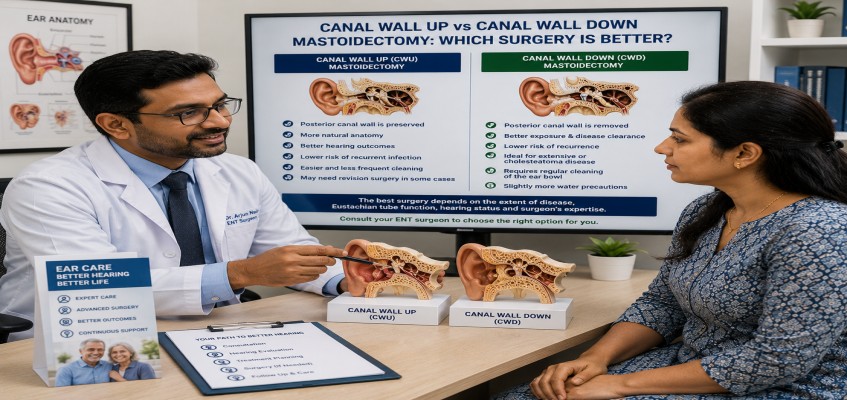
Canal wall up vs down mastoidectomy compares two common ways surgeons remove disease from the mastoid bone which is the air filled bone behind the ear. One method keeps the back wall of the ear canal intact while the other removes that wall to create a more open space.
Canal wall up vs down mastoidectomy is not a contest with one permanent winner. The better option depends on how extensive the infection or cholesteatoma is, how safely the surgeon can clear disease and how reliably you can attend follow ups. In this guide, we explain what each surgery means, how outcomes differ and what questions help you decide with your ENT team at Ascent Hospital, the best ENT Hospital in Kerala.
Why is a mastoidectomy recommended in the first place?
Mastoidectomy is usually advised when chronic ear disease spreads into the mastoid air cells. The most common reason is cholesteatoma, a destructive skin growth in the middle ear and mastoid that can erode bone and cause complications.
It may also be considered for persistent chronic suppurative otitis media, recurrent ear discharge, complications of ear infection or disease seen on scans that cannot be controlled with medicines alone. If you are also having eardrum repair or hearing reconstruction, mastoid surgery is often combined with tympanoplasty. (See: Mastoidectomy and Tympanoplasty Surgery in Kerala.)
If your symptoms started with repeated infections, it is worth getting a detailed evaluation early with an experienced ENT. You can also read about specialist care at Best Doctor for Ear Infection in Kerala.
What does the “canal wall” mean?
The ear canal has a bony back wall (posterior canal wall) that separates the canal from the mastoid area. In mastoid surgery, the surgeon works through the mastoid bone to remove infection or cholesteatoma.
In simple terms:
-
Canal Wall Up (CWU) keeps that bony ear canal wall.
-
Canal Wall Down (CWD) removes that wall, creating a larger open cavity that connects the mastoid to the ear canal.
Understanding this one difference helps you interpret everything else you will hear about canal wall up vs down mastoidectomy.
Canal Wall Up (CWU): What happens and why it is chosen
In a CWU mastoidectomy, the surgeon removes disease from the mastoid while preserving the posterior canal wall. The goal is to keep ear anatomy closer to normal.
Canal wall up vs down mastoidectomy discussions often start with CWU because it can offer a more natural ear canal shape after healing.
Potential advantages of CWU
CWU may be preferred when the disease is limited and complete clearance is achievable.
Commonly discussed benefits include:
-
Less likelihood of a large open cavity that needs frequent cleaning
-
Often fewer long term water precautions compared with a classic open cavity
-
Ear canal anatomy is preserved which may support hearing reconstruction in suitable cases
Important trade off
The main concern is residual or recurrent cholesteatoma because the preserved canal wall can limit direct visibility of some recesses. Many surgeons therefore plan close surveillance and in some cases a planned “second look” procedure depending on disease pattern and imaging.
Canal Wall Down (CWD): What happens and why it is chosen
In a CWD mastoidectomy, the posterior canal wall is removed. This makes the mastoid and ear canal one common space so the surgeon can see and access more areas directly.
When people ask which option wins in canal wall up vs down mastoidectomy, CWD is often viewed as the more definitive clearance approach for extensive disease.
Potential advantages of CWD
CWD is commonly considered when cholesteatoma is extensive, recurrent or associated with complications.
Typical benefits include:
-
Wide exposure that can help remove disease thoroughly
-
Lower risk of hidden residual cholesteatoma in certain patterns of disease
-
Easier postoperative inspection of the cavity during follow up visits
Important trade off
An open mastoid cavity can require periodic cleaning and may come with water precautions. Some patients also notice wax build up, discharge during infections or the need for ongoing care. Your surgeon may discuss techniques to reduce cavity problems in selected cases.
Canal wall up vs down mastoidectomy: A practical comparison
Below is a simplified comparison that many ENT surgeons use while counselling patients. balancing safe clearance with long term ear care.
Your exact plan depends on examination, hearing tests and imaging.
| Feature | Canal Wall Up (CWU) | Canal Wall Down (CWD) |
|---|---|---|
| Ear canal wall | Preserved | Removed |
| Best suited when | Limited disease and anatomy allows safe clearance | Extensive or recurrent cholesteatoma or high risk disease |
| Recurrence risk | Can be higher in some cases without careful surveillance | Often lower for hidden residual disease in suitable cases |
| Follow up needs | Close follow up, sometimes second look surgery or diffusion MRI | Regular cavity checks and cleaning may be needed |
| Water and ear care | Often fewer long term restrictions | Water precautions can be more important in many patients |
| Hearing reconstruction | Often done with tympanoplasty if feasible | Also possible, depends on disease and anatomy |
Which surgery is better for cholesteatoma?
The best surgery is the one that clears disease safely and matches your ability to follow a long term plan.
A few real world examples:
If cholesteatoma is extensive or recurrent
CWD may be recommended to maximise exposure and reduce hidden residual disease. This can be especially relevant if the disease involves difficult areas or if prior surgery has failed.
If cholesteatoma is limited and follow up is reliable
CWU may be appropriate when disease is localised and your surgeon is confident of complete clearance with the canal wall preserved. Follow up may include regular clinic checks and sometimes diffusion weighted MRI to look for recurrence depending on the case.
Does canal wall up vs down mastoidectomy affect hearing results?
Hearing outcomes depend more on the condition of the middle ear structures (eardrum and ossicles) than on the mastoid approach alone. In both CWU and CWD, surgeons may perform tympanoplasty or ossicular reconstruction when appropriate.
In some patients with advanced inner ear damage, options such as hearing aids or cochlear implants may be discussed. If you are exploring implant options, see Best cochlear implant surgeon in India.
At Ascent, ENT teams also support digital hearing aid fitting as part of comprehensive ear care.
What is recovery like after these surgeries?
Recovery varies by individual and by extent of disease. Many patients return to light activities within days, but ear healing and hearing stabilisation take longer.
In canal wall up vs down mastoidectomy, the difference is usually in long term care:
-
CWU patients may focus on scheduled follow ups to ensure no residual disease.
-
CWD patients may need periodic cavity cleaning and attention to water precautions.
Your surgeon will give personalised guidance on bathing, travel, swimming, ear drops and when to resume work.
What questions should you ask your ENT surgeon before deciding?
Using question style discussions during consultation can make the decision clearer.
“How extensive is my disease and what does my scan show?”
Extent often drives the choice more than preference.
“What is your main goal in my case: clearance, hearing, or reducing future care?”
Most plans aim for all three but priorities differ by case.
“Will I need a second look procedure or MRI follow up?”
This is especially important when choosing CWU.
“What long term care will I need if you do a canal wall down cavity?”
Ask about cleaning frequency, water precautions and expected lifestyle changes.
“Will you do tympanoplasty at the same time?”
If eardrum repair is planned, you can also discuss about tympanoplasty with Best tympanoplasty surgeons in kerala.
These questions help you weigh canal wall up vs down mastoidectomy based on your life and your risk profile.
Why surgeon experience and hospital support matter (especially for long term follow up)
Mastoid surgery is not only about the operation day. It is also about safe imaging, hearing testing and timely follow ups.
Ascent ENT Hospital is Kerala’s first ISO and NABH accredited ENT specialty hospital with advanced diagnostics, expert ENT surgeons and 24/7 ENT emergency care. If you are searching for an ENT hospital in Kerala or ENT in Calicut and want structured long term care, you can explore Ascent ENT Hospital Kerala.
Conclusion: Which is better?
Canal wall up vs down mastoidectomy is best decided case by case. CWU preserves the ear canal wall and can reduce cavity related care but it may require closer surveillance for recurrence. CWD offers wider exposure and can be better for extensive or recurrent cholesteatoma but it may involve ongoing cavity care and water precautions.
If you want a clear recommendation tailored to your ear examination, hearing test and scan, consult the team at Ascent Hospital, the best ENT Hospital in Kerala. To schedule an appointment, request a second opinion or plan surgery, book a consultation here: Contact Ascent Hospital.
Share
Share on WhatsApp
Our Professionals
 (1) (2).png)
Dr. Sharafudheen. P.K
Chief Consultant ENT & Cochlear Implant Surgeon
MBBS, MS (ENT), DORL DOHNS - RCS Ed (UK)
 (2).jpg)
Dr. Anuradha Varma. M.R
Senior Consultant ENT, Head & Neck Surgeon
MBBS, DLO
.jpeg)
Dr. Bijiraj Vathwam Veettil
Senior Consultant ENT Head & Neck, Sleep Surgeon
MBBS, MS (ENT), Fellowship in Snoring and Sleep apnea Surgeries (Singapore), Fellowship in sinus and skull base surgery
.png)
Dr. Prasanth Parameswaran
Senior Consultant ENT, Head & Neck Surgeon
MBBS, DLO, DNB (ENT), MNAMS, AASC (Specialist - Allergy and Immunotherapy), Fellowship in Snoring and Sleep apnea Surgeries (Singapore).

Dr. Arshad M Razi
Consultant ENT, Head & Neck Surgeon
MBBS, MS (ENT), Fellow in Head & Neck Surgical Oncology

Dr. Deepthi. N.V
Senior Consultant ENT, Head & Neck Surgeon
MBBS, DNB (ENT)


Dr. K Shilpa Nair
ENT Surgeon | Cochlear Implant & Sleep Surgery Specialist
MBBS, MS, DNB, MRCS(Eng), Post doctoral Fellowship in Implantation Otology


Dr. Nibi Shajahan
Consultant ENT, Head & Neck Surgeon
MBBS, MS (ENT), Fellowship in Snoring and Sleep apnea Surgeries (Singapore). Trained in Allergy and Immunotherapy



Dr.Anand Krishnan
Consultant ENT, Head and Neck Surgeon
MBBS ,DLO ,DNB ENT ,MRCS (ENGLAND)




Dr. Seshadri Ganesh. A.L
Senior Consultant Anaesthesiologist
MBBS, DCH, MD, DIP.N.B


Mr. Prasanth. N.P
Senior Audiologist & Speech Language Pathologist
BASLP, MASLP, MSc (Psy)

Ms. Chinju Johny
Audiologist & Speech Language Pathologist
BASLP, MSc (Audiology)



Our Patient Stories
View All Testimonials