Blogs
Phonosurgery for Vocal Fold Scar:Current Concepts, Treatment Options and Voice Recovery
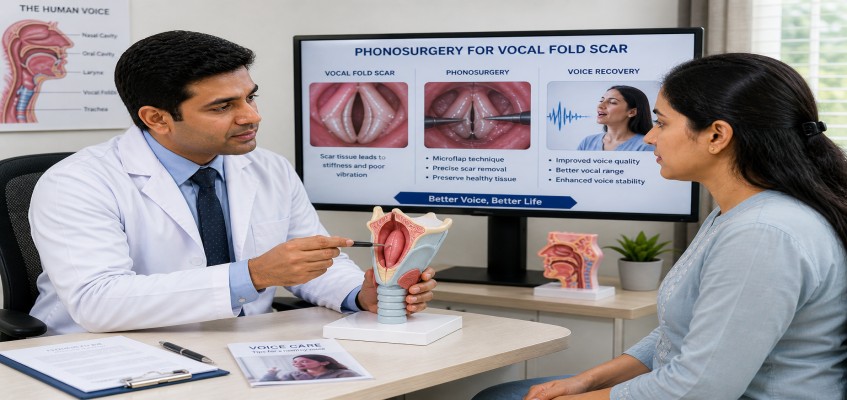
Phonosurgery for vocal fold scar is a group of precise procedures that help improve voice quality when scar tissue makes the vocal folds stiff. It aims to restore smoother vibration so the voice becomes clearer, stronger and less effortful.
Vocal fold scarring can follow long term voice strain inflammation, intubation injuries or previous throat procedures. This article explains current concepts behind phonosurgery for vocal fold scar and how specialists choose between injections, microsurgery and framework surgery. You will also learn what voice recovery typically involves and how to protect your results.
Phonosurgery for vocal fold scar: current concepts treatment options and voice recovery
Why vocal fold scars change the voice
Your vocal folds are designed to vibrate like soft flexible tissue. A scar can replace that flexible layer with firmer tissue. The result is often a weaker vibration and an uneven closure when you speak.
Common symptoms include persistent hoarseness, breathiness, reduced pitch range, vocal fatigue and loss of vocal stamina. Many patients notice the problem most during long conversations, phone calls teaching singing or public speaking.
How do specialists evaluate vocal fold scar before surgery?
A good plan starts with a detailed diagnosis because not every rough voice is caused by scarring alone. Before recommending phonosurgery for vocal fold scar your ENT team typically assesses:
-
Detailed history (voice use, reflux, allergies, smoking, prior surgeries)
-
Endoscopic examination of the larynx
-
Videostroboscopy to assess the mucosal wave and closure pattern
-
Voice assessment with acoustic measures and perceptual scoring
-
Trial of voice therapy when appropriate
This workup helps answer the key question: is the main problem stiffness or reduced closure or both? That distinction guides the choice of procedure.
When should you consider phonosurgery for vocal fold scar?
Many patients improve with careful voice therapy, hydration, reflux control and avoidance of vocal strain. Phonosurgery for vocal fold scar is usually considered when symptoms persist despite conservative care and when the scar clearly limits vibration or closure on stroboscopy.
You may be a stronger candidate if you have:
-
A stable long standing voice problem that has not improved with therapy
-
A clear glottic gap (incomplete closure) causing breathiness
-
Significant stiffness that limits the mucosal wave
-
Professional voice needs where small improvements matter
A specialist will also review expectations. Scar treatment often aims for meaningful improvement rather than a perfect return to a pre-scar voice.
Current concepts: what modern phonosurgery tries to achieve
The goal of phonosurgery for vocal fold scar is not just to “remove the scar”. Scar tissue cannot always be fully reversed. Instead modern laryngology focuses on improving how the vocal folds work together during vibration.
Key concepts include:
1) Improve closure without adding strain
If the folds do not meet well, air leaks through them and the voice becomes breathy. Some procedures improve closure so you can speak with less strain.
2) Restore pliability where possible
A scar can reduce flexibility of the vibrating layer. Selected techniques attempt to improve tissue properties or redistribute tension.
3) Use staged or combined treatment when needed
It is common to perform procedures in stages. For example an injection may be used first to test whether better closure improves voice before planning a more invasive surgery.
What are the treatment options for phonosurgery for vocal fold scar?
Treatment is personalised based on the type of scar, the degree of stiffness, the amount of closure gap and the patient’s voice goals. In practice phonosurgery for vocal fold scar ranges from minimally invasive injections to microsurgery and framework procedures.
| Option | What it targets | Typical role in care | Notes to discuss with your surgeon |
|---|---|---|---|
| Voice therapy and vocal hygiene | Technique, breath support, reduced strain | First line for many patients | Often used before and after procedures |
| Injection augmentation (injection laryngoplasty) | Improves closure by adding bulk | Helpful when breathiness is from a gap | Material choice and durability vary |
| Steroid or regenerative injections (case dependent) | Aims to reduce inflammation and remodel scar | Selected scars with significant stiffness | Not suitable for every scar pattern |
| Microlaryngeal scar release techniques (case dependent) | Addresses focal scar and adhesions | Considered when stiffness is localised | Outcomes depend on scar depth and extent |
| Medialisation thyroplasty (framework surgery) | Improves closure by repositioning the fold | Often for persistent gap or weakness | Can be considered when injections are insufficient |
Non-surgical support that still matters
Even if surgery is planned conservative steps often improve the final outcome. These include reflux management, adequate hydration, allergy control, smoking cessation and structured voice therapy with a speech language pathologist.
Office based and minimally invasive procedures
In many settings injection procedures can be done without a full operating theatre. When closure is the main issue this can be an effective path. For some patients it also serves as a “diagnostic trial” to predict benefit from more permanent closure procedures.
Microsurgery and framework surgery
When stiffness is the dominant factor and clearly limits the mucosal wave the surgeon may discuss microsurgical approaches. When gap and closure mechanics dominate the problem a framework procedure may be considered to improve efficiency of voicing. A good laryngologist will explain why a chosen option fits your specific anatomy and voice demands.
Voice recovery after phonosurgery for vocal fold scar: what to expect
Recovery is a process not an event. After phonosurgery for vocal fold scar the vocal folds need time to settle and the brain needs time to adapt to a new vibration pattern.
Many care plans include:
-
A period of voice rest as advised by your surgeon
-
Gradual return to speaking with a structured schedule
-
Post operative voice therapy to reduce compensatory strain
-
Follow up stroboscopy to track vibration and closure
Improvement may be gradual over weeks to months depending on the procedure and the baseline scar. Your clinician will guide you on when it is safe to return to heavy voice use such as teaching singing or long meetings.
How to protect your voice long term
Whether you choose conservative care or phonosurgery for vocal fold scar long term habits strongly influence results.
-
Hydrate well and limit throat clearing
-
Warm up your voice before prolonged speaking
-
Avoid shouting or speaking over loud noise when possible
-
Manage reflux if present as advised by your doctor
-
Continue technique focused voice therapy if recommended
Why specialist care matters for vocal fold scar
Scar related dysphonia is one of the more complex voice conditions because it involves fine vibratory mechanics. Choosing an experienced team for phonosurgery for vocal fold scar can improve decision making around candidacy procedure selection and post operative rehabilitation.
At Ascent Hospital patients can access focused voice care through the Laryngology and Phonosurgery Specialist service line. Ascent is widely known as a best ENT Hospital in Kerala and provides comprehensive ear nose throat head and neck care with advanced technology. If you are searching for an ENT clinic in Kerala or a best ENT surgeon in Kerala this is where subspecialty voice evaluation can make a real difference.
You can also read Embrace the delight of phono surgery to understand how voice procedures are designed to restore confidence in communication.
Conclusion
Phonosurgery for vocal fold scar is focused on restoring better vibration and closure when scar tissue limits normal voice function. The best results come from accurate diagnosis, thoughtful selection of injections or surgery and structured voice rehabilitation. If your hoarseness, breathiness or vocal fatigue has not improved with basic care a specialist voice assessment can clarify what is actually happening at the vocal folds.
For expert evaluation and a personalised plan at Ascent ENT Hospital Kerala connect with the team at Ascent Hospital and schedule a consultation to discuss your options for phonosurgery for vocal fold scar and voice recovery.
Frequently Asked Questions
Can vocal fold scar heal on its own?
Mild scarring and inflammation can improve with time and excellent vocal habits. Established scar tissue often needs targeted treatment and a specialist evaluation.
Is phonosurgery painful?
Most patients describe throat discomfort or mild pain for a short period depending on the approach used. Your surgeon will provide a pain control plan.
How long does it take to hear voice improvement after treatment?
Some people notice changes quickly after closure improving procedures while others improve gradually over weeks to months especially when therapy is required to retrain technique.
Will I need voice therapy after surgery?
Voice therapy is commonly recommended because it reduces strain and helps you use the improved vocal fold mechanics effectively.
Can scarring come back after surgery?
Scar behaviour varies. Protecting your voice, managing reflux and following post procedure instructions helps reduce the chance of persistent irritation or new injury.
Share
Share on WhatsApp

Our Professionals
 (1) (2).png)
Dr. Sharafudheen. P.K
Chief Consultant ENT & Cochlear Implant Surgeon
MBBS, MS (ENT), DORL DOHNS - RCS Ed (UK)
 (2).jpg)
Dr. Anuradha Varma. M.R
Senior Consultant ENT, Head & Neck Surgeon
MBBS, DLO
.jpeg)
Dr. Bijiraj Vathwam Veettil
Senior Consultant ENT Head & Neck, Sleep Surgeon
MBBS, MS (ENT), Fellowship in Snoring and Sleep apnea Surgeries (Singapore), Fellowship in sinus and skull base surgery
.png)
Dr. Prasanth Parameswaran
Senior Consultant ENT, Head & Neck Surgeon
MBBS, DLO, DNB (ENT), MNAMS, AASC (Specialist - Allergy and Immunotherapy), Fellowship in Snoring and Sleep apnea Surgeries (Singapore).

Dr. Arshad M Razi
Consultant ENT, Head & Neck Surgeon
MBBS, MS (ENT), Fellow in Head & Neck Surgical Oncology

Dr. Deepthi. N.V
Senior Consultant ENT, Head & Neck Surgeon
MBBS, DNB (ENT)


Dr. K Shilpa Nair
ENT Surgeon | Cochlear Implant & Sleep Surgery Specialist
MBBS, MS, DNB, MRCS(Eng), Post doctoral Fellowship in Implantation Otology


Dr. Nibi Shajahan
Consultant ENT, Head & Neck Surgeon
MBBS, MS (ENT), Fellowship in Snoring and Sleep apnea Surgeries (Singapore). Trained in Allergy and Immunotherapy



Dr.Anand Krishnan
Consultant ENT, Head and Neck Surgeon
MBBS ,DLO ,DNB ENT ,MRCS (ENGLAND)





Dr. Seshadri Ganesh. A.L
Senior Consultant Anaesthesiologist
MBBS, DCH, MD, DIP.N.B


Mr. Prasanth. N.P
Senior Audiologist & Speech Language Pathologist
BASLP, MASLP, MSc (Psy)

Ms. Chinju Johny
Audiologist & Speech Language Pathologist
BASLP, MSc (Audiology)



Our Patient Stories
View All Testimonials