Blogs
Air Bone Gap: Causes, Diagnosis & Its Role in Hearing Loss

An air bone gap is the difference between the hearing level measured through air and the hearing level measured through bone. Put simply, it can show whether sound is having trouble travelling through the outer or middle ear before it reaches the inner ear.
This difference is one of the useful clues audiologists look at during a hearing test. An air bone gap can be linked with conductive hearing loss, but the result does not always tell the whole story on its own. The size of the gap, the frequencies where it appears and other hearing test results all matter.
If you have noticed that people seem to mumble, you keep turning up the television or one ear does not seem to hear as well as before, it may be time to look into it. Our article titled Hearing Loss Bothering You? explains some common signs that are easy to overlook in everyday life.
At Ascent Hospital, ENT and audiology services can be used together when a hearing problem needs a closer look. This can be especially useful when the hearing test shows an unusual pattern rather than a straightforward hearing loss.
What is an Air Bone Gap?
Before getting into the causes, it helps to understand how the hearing test actually works.
During pure tone audiometry, sounds are usually presented through headphones or insert earphones. This measures air conduction. The sound has to travel through the ear canal, eardrum and middle ear before reaching the inner ear.
Bone conduction is tested differently. A small vibrator is placed against the bone behind the ear. It sends vibrations through the skull towards the inner ear and bypasses much of the outer and middle ear.
The difference between the air conduction and bone conduction thresholds is called the air bone gap.
For example, if a person has an air conduction threshold of 45 dB and a bone conduction threshold of 20 dB at the same frequency, the difference is 25 dB.
That difference may suggest that sound is not travelling normally through the outer or middle ear.
It is worth remembering, though, that hearing tests are not interpreted by looking at one number. Audiologists look at the complete audiogram, symptoms and other test findings before deciding what the pattern means.
Why is the Air Bone Gap Important?
The main reason doctors pay attention to an air bone gap is that it can help separate different types of hearing loss.
There are three broad categories:
-
Conductive hearing loss
-
Sensorineural hearing loss
Conductive hearing loss generally involves the outer or middle ear. Something is stopping sound from reaching the inner ear efficiently.
Sensorineural hearing loss usually involves the inner ear or the auditory nerve pathways. In this type of hearing loss, air and bone conduction results are often reduced together without a significant gap.
Mixed hearing loss has both components. A person may have an inner-ear hearing problem as well as another issue affecting sound transmission.
This distinction is important because treatment can be very different depending on the cause.
A detailed Audiology assessment can help identify the type and degree of hearing loss instead of simply reporting that someone has "poor hearing."
What Causes an Air Bone Gap?
Several conditions can lead to an air bone gap. Some are common and fairly straightforward to treat. Others need a more detailed ENT examination.
Earwax Build-Up
A large amount of earwax can block the ear canal and prevent sound from reaching the eardrum properly.
This may produce a conductive hearing loss pattern. Once the blockage is managed, hearing may improve.
Still, it is better not to assume that wax is responsible for a hearing change without having the ear examined. Trying to remove deep wax at home can sometimes make the situation worse. Read more about best earwax removal methods by Kerala ENT clinics.
Middle Ear Fluid
Fluid behind the eardrum can interfere with the normal movement of the middle ear.
It may develop after an infection or because of Eustachian tube problems. People often describe the hearing as muffled or blocked, almost as though they are listening through water.
Middle ear fluid is especially common in children, although adults can experience it too.
Ear Infections
An ear infection can cause inflammation and fluid inside the middle ear. Hearing may become temporarily reduced while the infection is present.
If the hearing does not return after the infection settles or if ear infections keep coming back, an ENT assessment is useful.
Perforated Eardrum
A perforated eardrum means that there is a hole or tear in the eardrum. Because the eardrum is part of the normal sound transmission system, a perforation can affect hearing. The amount of hearing loss depends on the size and position of the perforation and whether other middle ear structures are involved.
Ossicular Problems
The middle ear contains three tiny bones called the malleus, incus and stapes. Together, they transfer vibrations from the eardrum towards the inner ear.
If one of these bones becomes fixed, damaged or displaced, sound transmission may be reduced.
Trauma, previous infection and some ear conditions can affect these small bones.
Otosclerosis
Otosclerosis is another important cause of an air bone gap. It involves abnormal bone remodelling around the stapes, one of the tiny bones in the middle ear.
When the stapes become less mobile, sound cannot be transferred into the inner ear as efficiently.
You can learn more about this particular condition in Air-Bone Gap in Otosclerosis, especially if your audiogram has shown a conductive component.
Can an Air Bone Gap Happen Without a Typical Middle Ear Problem?
Yes and this is one reason why interpreting an audiogram properly matters.
Certain inner-ear conditions can produce an apparent conductive pattern even when the middle ear itself appears normal. Superior semicircular canal dehiscence is one example. Research has reported low-frequency air bone gaps in patients with this condition despite normal middle ear function.
There can also be differences caused by the hearing test itself. So, seeing a gap on an audiogram does not automatically mean that someone has a middle ear disorder. The rest of the hearing test has to be considered.
How is an Air Bone Gap Diagnosed?
A hearing test is usually the starting point.
Pure Tone Audiometry
Pure tone audiometry measures the softest sounds a person can hear at different frequencies.
Both air and bone conduction are tested. The results are then plotted on an audiogram so the audiologist can compare the thresholds.
An air bone gap of around 15 dB or more is commonly considered a possible conductive component, although the pattern needs to be interpreted in context. A recent study also highlights why isolated gaps, particularly at certain frequencies, should not automatically be treated as proof of conductive hearing loss.
Tympanometry
Tympanometry looks at how the eardrum and middle ear respond to changes in air pressure.
It can help identify problems such as abnormal middle ear pressure, fluid or reduced eardrum movement.
This test is useful because it gives information about middle ear function that cannot be obtained from pure tone audiometry alone.
Read our guide on Audiometry and Tympanometry to learn more about these hearing tests.
Ear Examination
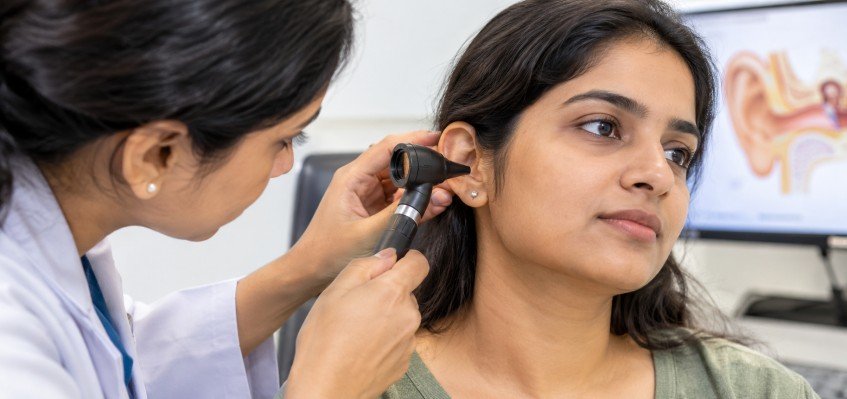
An ENT specialist in Kerala will usually examine the ear canal and eardrum as part of the assessment. This can reveal wax, infection, discharge, a perforation or other visible changes.
When a hearing test shows an air bone gap, this physical examination can help connect the audiogram finding with a possible cause.
Additional Tests
Not everyone needs additional investigations.
Depending on the hearing pattern and symptoms, an audiologist or ENT doctor in Kerala may recommend speech audiometry, acoustic reflex testing or other hearing assessments.
Imaging such as a CT scan may also be considered in selected cases when the diagnosis is unclear or when a structural problem needs further evaluation.
If you are comparing specialist care options, How to Choose the Best ENT for Treatment covers some of the practical things patients can consider before making an appointment.
Understanding the Audiogram
An audiogram can look complicated when you first see one. There are different symbols, numbers and frequencies, so it is easy to focus on one result and miss the overall pattern.
Here is a simple guide:
| Audiogram finding | What it may indicate |
|---|---|
| Air and bone thresholds are close together | Sensorineural pattern may be present |
| Air thresholds are poorer than bone thresholds | Conductive component may be present |
| Both are reduced and a gap is present | Mixed hearing loss may be possible |
| Gap appears at one frequency | Further interpretation may be needed |
| Gap appears across several frequencies | Conductive involvement may be more likely |
The size of the gap is only part of the picture. Audiologists also consider the shape of the hearing loss, speech understanding, tympanometry and the physical condition of the ear.
That is why reading an audiogram from a website and trying to diagnose yourself can easily lead to the wrong conclusion.
Air Bone Gap and Conductive Hearing Loss
A noticeable air bone gap is often associated with a conductive component.
Conductive hearing loss means that sound is not travelling efficiently through the outer or middle ear. Earwax, fluid, infections, eardrum problems and ossicular disorders are some possible causes.
The treatment depends on what is creating the problem. For example, earwax may be managed quite simply, while chronic middle ear disease could require medical or surgical treatment. Otosclerosis may also require a different approach altogether.
So, the gap itself is not the treatment. It is a clue that helps the doctor work out where the problem may be.
If you need specialist assessment, information about the best doctor for hearing loss in Kerala can help you understand what to consider when choosing a hearing care provider.
When Should You See an ENT Specialist?
Hearing loss does not always arrive suddenly. Sometimes it starts with small things. You may ask people to repeat themselves more often. Conversations in restaurants become harder to follow. You increase the television volume without really noticing. These changes are worth paying attention to.
A sudden change in hearing is more urgent and should be assessed promptly. Hearing loss accompanied by severe dizziness, ear discharge, significant pain or other sudden symptoms also deserves medical attention.
An ENT doctor can examine the ear and decide whether audiology testing or further investigations are appropriate.
For patients who need specialist care in Malappuram district, Ascent ENT hospital Perinthalmanna is one of the hospital locations available for ENT services.
Can an Air Bone Gap Be Treated?
There is no single treatment because an air bone gap can have different causes.
If earwax is responsible, removing the blockage may improve the hearing. If middle ear fluid or an infection is involved, treatment is directed towards that problem.
A perforated eardrum may heal on its own in some situations, while persistent perforations can require further treatment.
Problems involving the middle ear bones may also need specialist management. In selected cases, surgery may be discussed.
Hearing aids can be useful for some people as well. Whether they are appropriate depends on the type and degree of hearing loss and the condition of the ear.
The important thing is to identify the cause first.
The Role of Audiology in Hearing Assessment
Audiology is not simply about checking whether someone can hear a sound.
A complete assessment can look at different frequencies, speech understanding, air and bone conduction and middle ear function. These results help build a clearer picture of what is happening.
At Ascent, the Audiology & Speech Language Pathology department provides hearing assessment services including pure tone audiometry, speech audiometry, tympanometry and other specialised tests. This can be particularly useful when the hearing pattern is not straightforward.
For example, two people may both report that they cannot hear clearly, but one may have conductive hearing loss while the other has sensorineural hearing loss. Their evaluation and treatment can therefore be quite different.
Finding the Right ENT Care in Kerala
When hearing loss continues for weeks or months, it is usually better to get it assessed rather than simply adjusting the television volume or avoiding noisy places.
People searching for an ENT clinic in Kerala may want to consider whether the centre offers both ENT consultation and appropriate hearing diagnostics.
The location can also matter. Travelling a long distance for every follow-up may not be practical, especially when repeated hearing tests are needed.
For patients who are closer to Kozhikode, Ascent ENT Hospital in Calicut provides ENT services and hearing-related care.
A good assessment should focus on the person's actual hearing pattern rather than assuming that every hearing problem has the same cause.
Why the Cause Matters More Than the Number
It can be tempting to look at an audiogram and focus immediately on the size of the gap. But a 20 dB gap does not mean exactly the same thing in every patient. The frequency where the gap appears matters. The rest of the audiogram matters. Tympanometry matters. Symptoms matter too.
This is particularly important because research has shown that false air bone gaps can occur in sensorineural hearing loss, especially at certain frequencies. For this reason, the goal of testing is not simply to find an air bone gap. The real goal is to understand why it is there.
Patients comparing specialist options may come across searches for the best ENT doctor in Kerala. In practice, the more useful question is whether the doctor and supporting team can properly investigate the type of hearing problem you actually have.
ENT and Hearing Care at Different Ascent Locations
Hearing and ear problems can require more than one appointment, particularly when additional testing or follow-up is needed.
Ascent provides ENT services at multiple locations in Kerala. For patients in Palakkad, Ascent ENT hospital Palakkad provides another option for specialist ENT care.
Our website also provides information for people researching an ENT specialist in Kerala before arranging an evaluation.
For some patients, the concern may be straightforward hearing loss. For others, the audiogram may show a conductive component that needs more investigation.
Either way, getting the finding interpreted correctly is more useful than trying to diagnose the cause from the audiogram alone.
What Makes Specialist Evaluation Important?
A hearing test can tell you what you are hearing. An ENT assessment helps look at why the hearing may have changed. That distinction matters.
If the problem is wax, fluid or infection, the management may be relatively simple. If the cause involves the ossicles, otosclerosis or another structural problem, a more detailed evaluation may be needed.
People looking for the best ENT surgeon in Kerala may therefore want to consider the type of ear problem being evaluated, the diagnostic facilities available and whether the care team can provide the appropriate follow-up.
Ascent Hospital offers dedicated ENT and hearing-related services as part of its specialist care.
Is Ascent Hospital the Right Place for Hearing Evaluation?
There is no single hearing test that answers every question. A patient may start with an audiogram, then need an ear examination or tympanometry. Someone else may need further investigation because the hearing pattern is unusual.
This is where having ENT and audiology services available together can make the process more straightforward.
Ascent provides ENT and audiology care, with hearing tests and diagnostic facilities available through its audiology department.
Patients researching the best ENT hospital in Kerala can look at the range of diagnostic and treatment services available rather than judging a hearing problem from one test result alone.
For patients searching specifically for Ascent ENT hospital Kerala, we have locations including Kozhikode, Perinthalmanna and Palakkad.
Final Thoughts
An air bone gap is an important finding on a hearing test because it can provide a clue about how sound is travelling through the ear. A difference between air and bone conduction may point towards a conductive component, but it should never be interpreted completely on its own.
Earwax, middle ear fluid, infections, eardrum problems, ossicular disorders and otosclerosis are some possible causes. At the same time, research shows that apparent gaps can occasionally occur for other reasons, which is why the full audiogram and clinical examination matter.
If your hearing test has shown an air bone gap, the next step is not necessarily to worry about the number. The more useful step is to understand what is causing it and whether that cause can be treated.
Ascent Hospital provides ENT and audiology services for patients with different types of ear and hearing concerns. If you have noticed a change in hearing you can schedule a consultation with Ascent Hospital to discuss the findings with the appropriate specialist.
Frequently Asked Questions
1. Is an air bone gap always caused by conductive hearing loss?
No. It can suggest a conductive component, but some testing factors and certain inner-ear conditions can also create an apparent gap.
2. What size air bone gap is significant?
A difference of around 15 dB or more is commonly considered clinically relevant, but the complete audiogram needs to be interpreted.
3. Can earwax cause an air bone gap?
Yes. A significant blockage in the ear canal can interfere with normal sound transmission and affect the air conduction result.
4. Can an air bone gap be present in both ears?
Yes. Depending on the underlying condition, the pattern may affect one ear or both.
5. Does an air bone gap mean that surgery is needed?
No. Treatment depends on the cause. Some cases can be managed medically, while others may require hearing devices or surgery.
6. Can air bone gaps disappear?
It can, particularly when the cause is temporary or treatable, such as certain middle ear problems or blockage in the ear canal.
Share
 (1) (2).png)

Our Professionals
Dr. Sharafudheen. P.K
Chief Consultant ENT & Cochlear Implant Surgeon
MBBS, MS (ENT), DORL DOHNS - RCS Ed (UK)
 (2).jpg)
Dr. Anuradha Varma. M.R
Senior Consultant ENT, Head & Neck Surgeon
MBBS, DLO
.jpeg)
Dr. Bijiraj Vathwam Veettil
Senior Consultant ENT Head & Neck, Sleep Surgeon
MBBS, MS (ENT), Fellowship in Snoring and Sleep apnea Surgeries (Singapore), Fellowship in sinus and skull base surgery
.png)
Dr. Prasanth Parameswaran
Senior Consultant ENT, Head & Neck Surgeon
MBBS, DLO, DNB (ENT), MNAMS, AASC (Specialist - Allergy and Immunotherapy), Fellowship in Snoring and Sleep apnea Surgeries (Singapore).

Dr. Arshad M Razi
Consultant ENT, Head & Neck Surgeon
MBBS, MS (ENT), Fellow in Head & Neck Surgical Oncology

Dr. Deepthi. N.V
Senior Consultant ENT, Head & Neck Surgeon
MBBS, DNB (ENT)


Dr. K Shilpa Nair
ENT Surgeon | Cochlear Implant & Sleep Surgery Specialist
MBBS, MS, DNB, MRCS(Eng), Post doctoral Fellowship in Implantation Otology


Dr. Nibi Shajahan
Consultant ENT, Head & Neck Surgeon
MBBS, MS (ENT), Fellowship in Snoring and Sleep apnea Surgeries (Singapore). Trained in Allergy and Immunotherapy



Dr.Anand Krishnan
Consultant ENT, Head and Neck Surgeon
MBBS ,DLO ,DNB ENT ,MRCS (ENGLAND)




Dr. Seshadri Ganesh. A.L
Senior Consultant Anaesthesiologist
MBBS, DCH, MD, DIP.N.B


Mr. Prasanth. N.P
Senior Audiologist & Speech Language Pathologist
BASLP, MASLP, MSc (Psy)

Ms. Chinju Johny
Audiologist & Speech Language Pathologist
BASLP, MSc (Audiology)



Our Patient Stories
View All Testimonials