Blogs
Carhart Notch in Otosclerosis: Audiogram Sign, Causes and Its Role in Diagnosing Conductive Hearing Loss
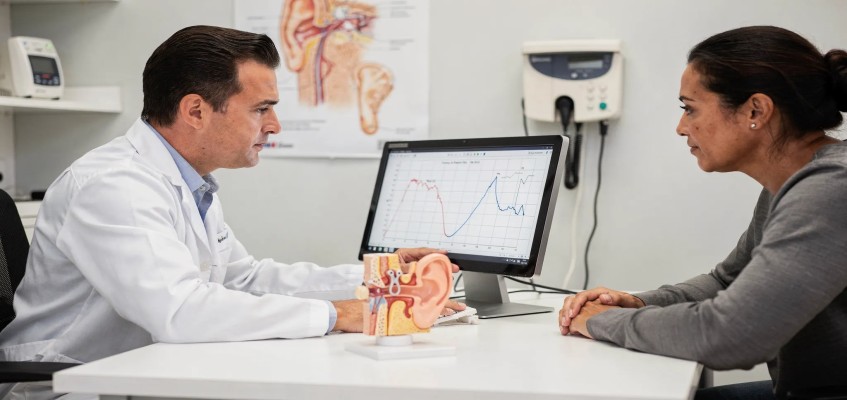
Carhart notch in otosclerosis is a characteristic dip seen on a hearing test graph called an audiogram. It points to a specific pattern of sound conduction problem in the middle ear.
In everyday practice this audiogram clue helps ENT specialists narrow down the cause of conductive hearing loss, especially when the eardrum looks normal on examination. This article explains what the notch means, why it happens, what else can mimic it and how it guides diagnosis and treatment decisions.
Carhart notch in otosclerosis: what it looks like on an audiogram
An audiogram plots hearing thresholds for air conduction (sound travelling through the ear canal and middle ear) and bone conduction (sound delivered through skull vibration that bypasses much of the middle ear). In many conductive problems, air conduction is worse than bone conduction creating an air bone gap.
In carhart notch in otosclerosis, there is an additional clue: bone conduction thresholds show a small worsening, classically around 2 kHz. This creates a “notch like” dip that can make bone conduction look slightly poorer than expected for a purely conductive issue.
Why does the notch happen?
Otosclerosis most commonly involves abnormal bone remodelling around the stapes footplate leading to stapes fixation. When the stapes cannot move freely, the mechanics of sound transmission through the ossicular chain change.
In carhart notch in otosclerosis, the apparent drop in bone conduction is not always a true inner ear damage. It is largely a mechanical effect caused by altered middle ear resonance and reduced inertial contribution of the ossicles, most evident at specific frequencies.
A key clinical point: after successful stapes surgery, this notch often improves, supporting the idea that the notch is related to middle ear mechanics rather than permanent cochlear loss.
What causes otosclerosis in the first place?
The exact cause of otosclerosis is multifactorial. ENT literature commonly recognises these contributors:
-
Genetic predisposition (often familial)
-
Hormonal influences (symptoms can progress during pregnancy in some patients)
-
Possible viral or immune mediated factors (still under study)
When these factors lead to stapes fixation, the patient typically develops slowly progressive hearing loss. Some patients also report tinnitus or imbalance.
How to read the audiogram pattern in suspected otosclerosis
The audiogram is only one part of the diagnosis but it is often the first objective test that raises suspicion.
In carhart notch in otosclerosis, common audiogram features include:
-
Conductive hearing loss with a clear air bone gap
-
Bone conduction dip classically near 2 kHz
-
Speech discrimination often relatively good in early disease (unless there is mixed loss)
How is this different from other conductive hearing loss patterns?
The notch is suggestive but not exclusive. Use it as a clue that must match the history, ear exam and impedance testing.
| Finding | Suggests otosclerosis with Carhart notch | More typical of other causes |
|---|---|---|
| Ear drum appearance | Often normal | Can be normal or abnormal (for example retraction, perforation) |
| Air bone gap | Common | Common |
| Bone conduction dip near 2 kHz | Common feature in Carhart notch in otosclerosis | Less typical in otitis media with effusion or ossicular discontinuity |
| Tympanometry | Often Type As (stiff system) | Effusion often Type B, ossicular discontinuity often Type Ad |
| Acoustic reflexes | Often absent | May be present depending on condition |
Clinical tip: impedance audiometry (tympanometry with reflexes) adds strong support when the audiogram suggests otosclerosis.
Its role in diagnosing conductive hearing loss
On its own, carhart notch in otosclerosis is not a final diagnosis. Its real value is how it increases diagnostic confidence when combined with the full clinical picture.
A typical pathway looks like this:
-
Symptoms: gradual hearing loss in one or both ears, sometimes tinnitus
-
Otoscopy: normal looking tympanic membrane
-
Audiogram: conductive loss with the notch pattern
-
Tympanometry and reflexes: stiffness pattern with absent reflexes
-
Imaging: CT temporal bone in selected cases to assess anatomy, exclude other pathology and plan surgery
When these align, carhart notch in otosclerosis becomes a practical sign that helps separate otosclerosis from middle ear fluid, chronic infection or ossicular chain disruption.
Does carhart notch in otosclerosis prove you have otosclerosis?
No. Carhart notch in otosclerosis is a supportive audiogram sign, not a standalone proof.
Some patients can show a similar looking notch due to other mechanical or measurement factors. That is why ENT specialists correlate it with tympanometry, reflex testing and clinical findings. If there are red flags such as sudden onset, fluctuating hearing or neurological symptoms, your ENT doctor may broaden the workup.
Can carhart notch in otosclerosis be present with mixed hearing loss?
Yes. Otosclerosis can progress beyond stapes fixation. Some patients develop cochlear involvement (often called cochlear otosclerosis) leading to mixed hearing loss.
If you want to read about this spectrum, see Ascent’s detailed guide on Cochlear Otosclerosis.
How the sign influences treatment decisions
The management of suspected otosclerosis depends on hearing levels, symptoms, daily communication needs, medical fitness for surgery and patient preference.
When carhart notch in otosclerosis is part of a consistent diagnostic picture, treatment discussions often include:
Hearing aids and hearing rehabilitation
Many patients do very well with modern digital hearing aids, especially in early to moderate conductive loss. A proper hearing aid trial can also help patients who are not ready for surgery.
If you are looking for a specialist assessment, Ascent Hospital has dedicated hearing care services and ENT expertise. Learn more about the team at Ascent Hospital and consult a Best Doctor for Hearing Loss in Kerala.
Stapes surgery (stapedotomy or stapedectomy)
For suitable candidates, surgery aims to bypass the fixed stapes and improve sound conduction. In many cases, successful surgery reduces the air bone gap and can improve the mechanical component responsible for carhart notch in otosclerosis.
If you are exploring surgical options, you can read about choosing a Best Stapedotomy Surgeon in India.
When cochlear implantation is considered
In advanced cases with significant inner ear involvement, cochlear implantation may be discussed. Ascent ENT Hospital Kerala also provides specialised services such as Cochlear Implant Surgery in Kerala depending on clinical suitability.
Why specialist evaluation matters
Because conductive hearing loss can have multiple causes, the best next step after an audiogram is a structured ENT evaluation. At Ascent Hospital, widely recognised as a best ENT Hospital in Kerala, ENT specialists combine clinical examination with audiology, imaging when needed and procedure planning.
If you search for an ENT clinic in Kerala, you can start at Ascent ENT Hospital Kerala where comprehensive ear nose throat and head and neck care is available including advanced diagnostics and 24/7 ENT emergency care.
Conclusion
Carhart notch in otosclerosis is an audiogram sign where bone conduction thresholds dip, often around 2 kHz, in a pattern that supports stapes fixation as a cause of conductive hearing loss. It is most useful when it matches the patient’s symptoms, a normal ear drum exam and supportive impedance findings such as a stiff tympanogram and absent acoustic reflexes.
If you or a family member has persistent conductive hearing loss, do not rely on the audiogram alone. Get a complete ENT evaluation to confirm the cause and discuss options such as hearing aids, stapes surgery or advanced hearing rehabilitation.
To book an appointment or schedule a consultation with Ascent, use the contact page.
Share
Share on WhatsApp

Our Professionals
 (1) (2).png)
Dr. Sharafudheen. P.K
Chief Consultant ENT & Cochlear Implant Surgeon
MBBS, MS (ENT), DORL DOHNS - RCS Ed (UK)
 (2).jpg)
Dr. Anuradha Varma. M.R
Senior Consultant ENT, Head & Neck Surgeon
MBBS, DLO
.jpeg)
Dr. Bijiraj Vathwam Veettil
Senior Consultant ENT Head & Neck, Sleep Surgeon
MBBS, MS (ENT), Fellowship in Snoring and Sleep apnea Surgeries (Singapore), Fellowship in sinus and skull base surgery
.png)
Dr. Prasanth Parameswaran
Senior Consultant ENT, Head & Neck Surgeon
MBBS, DLO, DNB (ENT), MNAMS, AASC (Specialist - Allergy and Immunotherapy), Fellowship in Snoring and Sleep apnea Surgeries (Singapore).

Dr. Arshad M Razi
Consultant ENT, Head & Neck Surgeon
MBBS, MS (ENT), Fellow in Head & Neck Surgical Oncology

Dr. Deepthi. N.V
Senior Consultant ENT, Head & Neck Surgeon
MBBS, DNB (ENT)


Dr. K Shilpa Nair
ENT Surgeon | Cochlear Implant & Sleep Surgery Specialist
MBBS, MS, DNB, MRCS(Eng), Post doctoral Fellowship in Implantation Otology


Dr. Nibi Shajahan
Consultant ENT, Head & Neck Surgeon
MBBS, MS (ENT), Fellowship in Snoring and Sleep apnea Surgeries (Singapore). Trained in Allergy and Immunotherapy



Dr.Anand Krishnan
Consultant ENT, Head and Neck Surgeon
MBBS ,DLO ,DNB ENT ,MRCS (ENGLAND)





Dr. Seshadri Ganesh. A.L
Senior Consultant Anaesthesiologist
MBBS, DCH, MD, DIP.N.B


Mr. Prasanth. N.P
Senior Audiologist & Speech Language Pathologist
BASLP, MASLP, MSc (Psy)

Ms. Chinju Johny
Audiologist & Speech Language Pathologist
BASLP, MSc (Audiology)



Our Patient Stories
View All Testimonials