Blogs
How to Stop Mouth Breathing? Causes, Risks and Fixes That Work

Mouth breathing is exactly what it sounds like: pulling air in and out through the mouth instead of the nose. Almost everyone does it now and then. But it becomes a real concern once it turns into your default way of breathing, especially at night.
If you are searching for how to stop mouth breathing, you are probably past the "just a habit" stage, maybe waking up with a dry throat every morning or hearing that you sleep with your mouth wide open. This article covers why the habit forms, what it does to your body over time and which fixes actually work. Kerala's humid weather and heavy pollen load also mean a lot of local cases come down to blocked nasal passages rather than a bad habit on its own. And getting that distinction right at Ascent Hospital is usually the fastest way to fix it for good.
It is not only a sleep issue either. Left alone, it can affect jaw growth in children, posture and daytime energy.Which is why the approach here is finding the actual cause and treating it, the same principle the team at Ascent ENT hospital Kerala uses with every patient who walks in complaining of breathing through mouth at night.
What Causes Mouth Breathing in the First Place?
Nobody just decides to breathe through their mouth. Something usually blocks the nasal route and the mouth takes over because it is the easier path at that moment.
Common causes include:
-
A blocked or swollen nose from allergies, colds or sinus infections
-
Enlarged adenoids or tonsils, especially common in kids
-
A deviated nasal septum that narrows one or both nostrils
-
Chronic sinusitis or nasal polyps
-
Simple habit, sometimes left over from a childhood cold that never really got resolved
Allergies deserve a special mention here because they are sneaky. You might not feel "sick," just a bit stuffy and your body quietly starts favoring mouth breathing without you registering the shift. If your nose feels blocked most mornings regardless of season, it is worth getting checked through Allergy Testing & Treatment rather than assuming it will pass on its own.
Structural issues are another big piece of the puzzle. A narrow airway, a crooked septum or swollen turbinates can physically restrict airflow no matter how much you try to breathe through your nose. In those cases no amount of willpower fixes it, the air simply cannot get through. And learning how to stop mouth breathing here means treating the structure, not the habit.
Is Mouth Breathing Bad? Side Effects You Should Know
Short answer, yes. The mouth breathing side effects add up faster than most people expect. This is exactly why so many people start searching for how to stop mouth breathing the moment they notice the pattern.
Here is a quick breakdown of what tends to happen with prolonged mouth breathing:
| Area affected | What typically happens |
|---|---|
| Mouth and throat | Dryness, bad breath, higher risk of cavities |
| Sleep quality | Frequent waking, snoring, poor rest even after 8 hours |
| Energy and focus | Daytime fatigue, brain fog, irritability |
| Facial structure (children) | Longer face, narrow jaw, so called adenoid face |
| Posture | Forward head posture as the body tries to keep the airway open |
| Heart and lungs | Increased strain over years if paired with sleep apnoea |
Dry mouth is the most immediate complaint. Since saliva keeps bacteria in check and mouth breathing washes that protection away overnight. Give it a few years of untreated mouth breathing problems and the picture gets more serious, touching gum health, sleep and even mood.
Mouth Breathing While Sleeping: Why It Gets Worse at Night
Mouth breathing while sleeping tends to be worse than daytime mouth breathing for a simple reason. You have no conscious control over it once you are asleep.
During the day you might catch yourself and close your mouth. At night, your muscles relax, your jaw drops slightly and the path of least resistance wins if your nose is blocked. This is also tied to snoring and in more serious cases, Snoring / Obstructive Sleep Apnoea, where breathing actually pauses repeatedly through the night.
If you are wondering how to stop mouth breathing while sleeping, the first honest step is figuring out whether it is a positional habit or a genuine airway blockage. Sleeping on your back, for instance, makes the jaw fall open more easily than sleeping on your side. So something as small as changing your sleep position can make a noticeable difference for mild cases.
For people who wake up gasping, snore loudly enough to disturb others or feel exhausted no matter how early they sleep, this stops being a minor annoyance and starts looking like something that needs a sleep evaluation.
Effects of Mouth Breathing on Face: Before and After
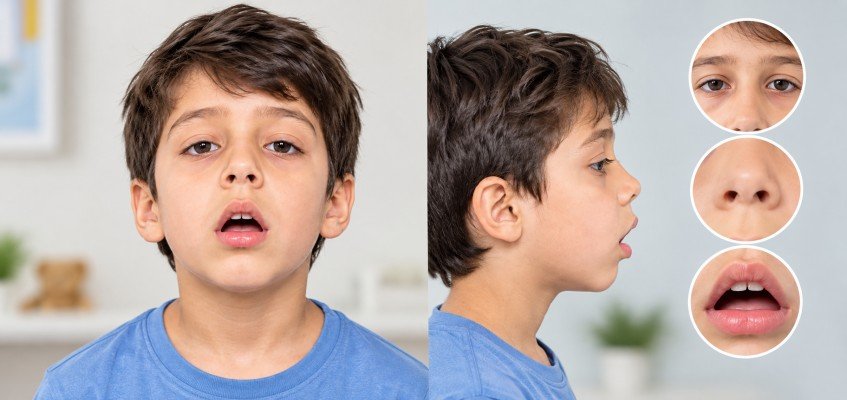
This is probably the part that worries parents the most and rightly so. The effects of mouth breathing on face structure are well documented, particularly in growing children whose bones are still soft and adaptable.
When a child breathes through the mouth for years, the tongue no longer rests against the roof of the mouth. That resting pressure actually helps shape the upper jaw as it grows. Without it, the palate can grow narrow and high, the face can grow longer than it should and the lower jaw can end up set further back. Dentists and an ENT doctor in Kerala often call this pattern mouth breathing adenoid face. And before and after mouth breathing photos in clinical literature show the difference clearly once you know what to look for, a flatter cheek profile, dark circles under the eyes and a slightly open resting mouth.
Adults are not immune either, though changes are slower since bone growth has already finished. Chronic mouth breathing in adults tends to show up as fatigue lines and a mild forward shift of head posture over years.
How to Stop Mouth Breathing in Children
Parents often ask how to stop mouth breathing in child cases early and that timing actually matters a lot. Catching it young means the fix is usually simpler and the facial growth changes can often be prevented or reversed. A lot of parents in and around Perinthalmanna bring their kids to Ascent ENT Hospital Perinthalmanna the moment they notice this pattern.
A few practical steps that help:
- Get the nose checked for chronic blockage, allergies or enlarged adenoids
- Treat recurring throat infections properly instead of letting them linger, since conditions like ongoing tonsillitis can keep the airway partially blocked for weeks at a stretch
- Encourage nose breathing exercises during calm, awake hours so it becomes the default
- Watch for snoring or restless sleep and get it evaluated rather than assuming the child will "grow out of it"
Waiting it out is the most common mistake parents make. A child who mouth breathes through most of their growing years can end up with facial and dental changes that are far harder to correct later. So figuring out how to stop mouth breathing early genuinely saves time and worry.
How to Stop Mouth Breathing While Sleeping: Fixes That Work
Now to the part everyone actually wants, how do you stop mouth breathing, practically speaking.
Home based steps worth trying first:
-
Saline rinses or a bit of steam inhalation before bed. Mainly to deal with congestion
-
Sleep on your side, not flat on your back
-
Don't let the bedroom air get too dry. Fans and AC running all night are usually the culprit
-
Practice some basic nose breathing drills during the day. Just so it starts feeling automatic
-
Deal with allergies as an ongoing thing, not just when they act up
These help for sure. But they're not going to fix an airway that's actually blocked. If what's really going on is a deviated septum, enlarged turbinates or some chronic sinus issue, home remedies are just covering it up. At that point you're looking at either medication or something like Septo Rhinoplasty, which fixes the structural problem so the nose can actually work the way it's supposed to.
It also helps to rule out allergic causes properly, since something like Allergic Rhinitis vs Sinusitis can look similar on the surface but need very different treatment approaches. Getting that diagnosis right avoids months of trial and error with the wrong medication.
And if the blockage just isn't budging with medication, surgery becomes the next reasonable step. Allergic Rhinitis Surgery or septal correction aren't things doctors jump to first. They come after conservative treatment has had a real chance and just hasn't worked.
When to See a Doctor
Not every case needs a specialist. But certain signs mean it is time to stop experimenting with how to stop mouth breathing on your own and get a proper evaluation from a best ENT doctor in Kerala:
-
Loud, persistent snoring or witnessed pauses in breathing during sleep
-
A child with visible facial changes, chronic mouth breathing or frequent ear infections
-
Nasal blockage that does not improve with medication after a few weeks
-
Daytime exhaustion despite what should be a full night's sleep
-
Recurring sinus infections alongside the breathing pattern
Getting the diagnosis right the first time matters more than people realize, since misdiagnosed nasal issues can drag on for years. That is part of why how to choose the best ENT for treatment is worth reading before booking a random appointment.
Conditions involving the throat head and neck region often overlap with nasal breathing issues.So a specialist who looks at the full picture tends to catch problems a narrower checkup would miss.
For blockage that keeps returning no matter how many rounds of medication you try, it may be worth a dedicated look at rhinology and sinus diseases treatment rather than repeating the same prescription.
Bringing It All Together
Mouth breathing rarely fixes itself with willpower alone. Most of the time there is an actual, treatable reason behind it. Whether that is allergies, a structural blockage or something as common as enlarged adenoids in a child. Left alone, it can quietly affect sleep, energy, dental health and even how a growing child's face develops.
The good news is that most causes respond well to proper treatment once identified correctly. And learning how to stop mouth breathing usually comes down to fixing the cause rather than fighting the symptom. If home changes like side sleeping and nasal rinses are not cutting it after a few weeks. That is the signal to get evaluated rather than keep guessing.
If you or your child are dealing with ongoing breathing through the mouth while sleeping, snoring or nasal blockage that will not clear up, it is worth speaking to a specialist rather than letting it drag on. The team at Ascent Hospital, recognized as the best ENT hospital in Kerala, can help identify the exact cause and walk you through the right treatment path, whether that means medication, allergy management or a corrective procedure.
If you are still deciding where to go, this guide on what to look for when choosing an ENT hospital covers the basics worth checking before you book. A good clinic usually shows it in small ways, like a thorough first consultation or a doctor who explains things simply instead of rushing you out.
For a broader comparison of clinics in the state, our piece on how to find the best ear nose and throat clinic is worth a read too. It is meant to save you the trouble of calling around and asking the same questions at five different places.
Ready to get your breathing checked properly? Contact Ascent Hospital today and schedule a consultation with our ENT specialists.
Frequently Asked Questions
1. Is mouth breathing bad for you long term?
Yes, over time it adds up, sleep gets worse, teeth and gums take a hit, kids' faces can grow differently and you're just more tired during the day.
2. How do you stop mouth breathing at night without surgery?
Side sleeping helps, so does clearing nasal congestion before bed and doing nose breathing drills during the day. But if the airway's actually blocked, exercises alone won't cut it.
3. Can adults reverse the effects of mouth breathing on face structure?
Once you're an adult, the bone changes are pretty much set. Still, fixing the actual cause stops things from getting worse. And often helps with the tiredness and that puffy look around the mouth.
4. How to avoid mouth breathing during the day?
Just start noticing where your mouth sits when you're not talking, deal with any blockage sooner rather than later. And try keeping your lips closed with your tongue up against the roof of your mouth.
Share
 (1) (2).png)

Our Professionals
Dr. Sharafudheen. P.K
Chief Consultant ENT & Cochlear Implant Surgeon
MBBS, MS (ENT), DORL DOHNS - RCS Ed (UK)
 (2).jpg)
Dr. Anuradha Varma. M.R
Senior Consultant ENT, Head & Neck Surgeon
MBBS, DLO
.jpeg)
Dr. Bijiraj Vathwam Veettil
Senior Consultant ENT Head & Neck, Sleep Surgeon
MBBS, MS (ENT), Fellowship in Snoring and Sleep apnea Surgeries (Singapore), Fellowship in sinus and skull base surgery
.png)
Dr. Prasanth Parameswaran
Senior Consultant ENT, Head & Neck Surgeon
MBBS, DLO, DNB (ENT), MNAMS, AASC (Specialist - Allergy and Immunotherapy), Fellowship in Snoring and Sleep apnea Surgeries (Singapore).

Dr. Arshad M Razi
Consultant ENT, Head & Neck Surgeon
MBBS, MS (ENT), Fellow in Head & Neck Surgical Oncology

Dr. Deepthi. N.V
Senior Consultant ENT, Head & Neck Surgeon
MBBS, DNB (ENT)


Dr. K Shilpa Nair
ENT Surgeon | Cochlear Implant & Sleep Surgery Specialist
MBBS, MS, DNB, MRCS(Eng), Post doctoral Fellowship in Implantation Otology


Dr. Nibi Shajahan
Consultant ENT, Head & Neck Surgeon
MBBS, MS (ENT), Fellowship in Snoring and Sleep apnea Surgeries (Singapore). Trained in Allergy and Immunotherapy



Dr.Anand Krishnan
Consultant ENT, Head and Neck Surgeon
MBBS ,DLO ,DNB ENT ,MRCS (ENGLAND)




Dr. Seshadri Ganesh. A.L
Senior Consultant Anaesthesiologist
MBBS, DCH, MD, DIP.N.B


Mr. Prasanth. N.P
Senior Audiologist & Speech Language Pathologist
BASLP, MASLP, MSc (Psy)

Ms. Chinju Johny
Audiologist & Speech Language Pathologist
BASLP, MSc (Audiology)



Our Patient Stories
View All Testimonials